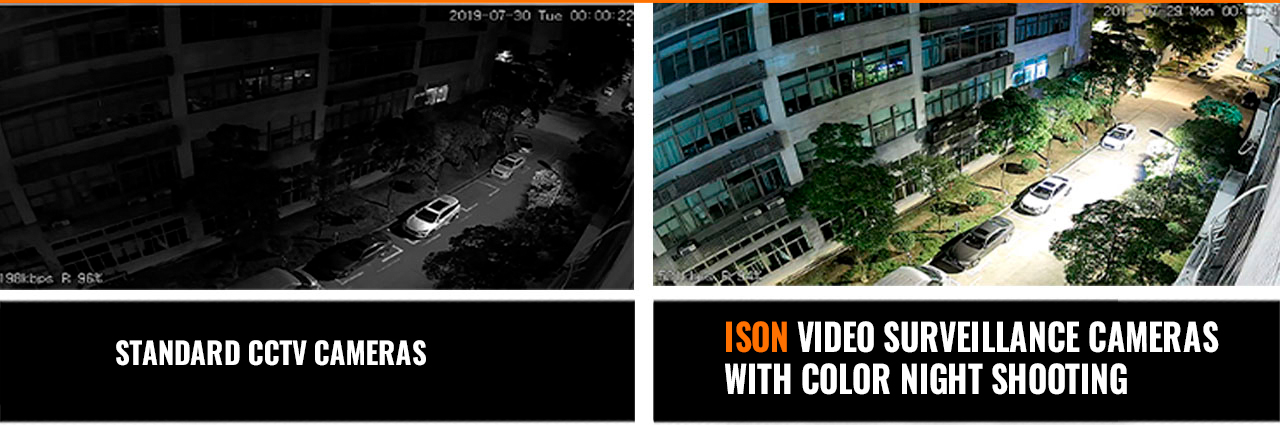


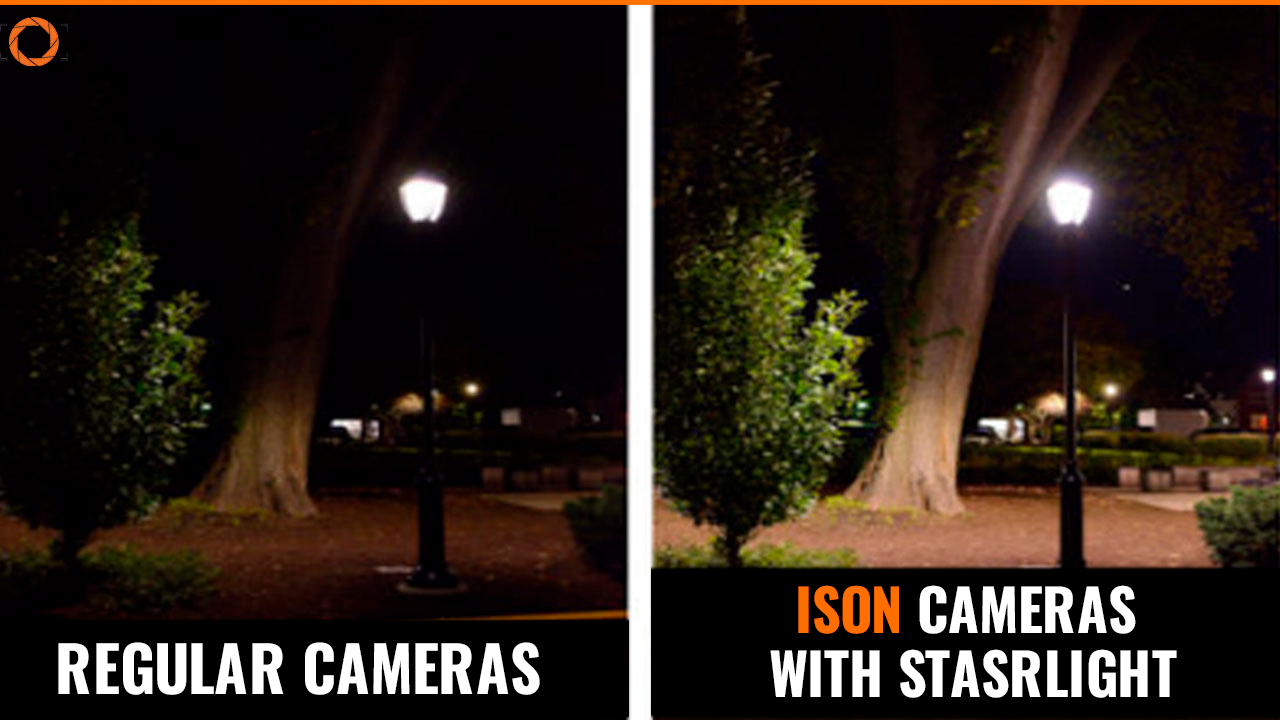




Types de caméras de vidéosurveillance. Comment choisir la bonne ?
TYPES OF CCTV CAMERAS. HOW TO CHOOSE A SURVEILLANCE CAMERA?
What are CCTV cameras, how to choose them correctly and avoid common mistakes when the selected cameras show poorly or do not have those functions that are necessary at your facility in your video surveillance system. In this article I will help you understand this issue, tell you not only mat part but also give useful tips that will help you not to face the problem of throwing away money when buying a system of CCTV cameras for your object. Also in this article I will give advice on specific models to make it easier for you to make your choice.
And so what are the different types of CCTV cameras there are
- Dome and cylindrical.
Dome cameras are mainly placed indoors, cylindrical cameras outside. But this is not the rule, if you want, you can put on the street and dome cameras, look only at its temperature mode of operation, because there are dome cameras that are made exclusively to work in the heat, and there are those that are not afraid of frost or precipitation. Also, if desired, you can easily put a cylindrical camera for the street inside the visit, it is a matter of design.
2. Cameras with 3.6mm lens, 2.8mm lens and fish eye cameras.
Cameras with a fish eye lens in 99% of cases is a bad idea to buy, because such cameras distort the picture and at a certain angle the person in the frame does not look like himself, which will greatly complicate your identification procedure.

The only task under which such cameras are suitable for is monitoring an elderly relative where you do not really care about the quality of filming and it is important to understand in which part of the room is a person and how active he is. Also such cameras are sometimes put in the ceiling in shopping centers for counting visitors and general control of the situation, but such cameras are always duplicated by cameras with a normal lens.

The main disadvantage of cameras with a 3.6mm lens is a relatively small viewing angle of 60 to 80 degrees on average, depending on the sensor.
The 2.8mm lens is currently the most popular lens, it gives cameras an angle of view of 90 to 120 degrees without distortion, making it the most popular lens for 95% of applications. We will talk about varifocal lenses later in a separate question.
3) Cameras without the function of viewing from a smartphone, cameras where there is such a function, cameras with support for 3g/4g, cameras with the function of viewing from a smartphone but supporting not all Internet operators.
The function of viewing from a smartphone allows you to view the picture online from your phone, there are also models that have the option to remotely view the archive for example for yesterday, as well as listen to the sound, turn the camera or zoom, if such functions in the camera provided.
If you do not need this function, you can choose the first option, if your facility does not have wired Internet and the Internet is distributed through a SIM card, you need the second option, but be sure to look at the description of your system was written to support exactly 3g/4g Internet, because there are special IP addresses, with which not all cameras and recorders do not work.
Well and the last point I specifically highlighted, because in the budget price segment there are often cameras and recorders that have a function of viewing from a smartphone declared, but to get it in practice will have to dance with a whirlwind in search of an operator with which it will still work. It is better to clarify this point and sellers before buying or choose a manufacturer that works with all telecom operators, for example ISON brand.
In order to generally not particularly bother in the matter of the Internet for their cameras and choose only from the options that work with all providers I recommend you to make a selection through a special configurator, which will automatically pick you out of 1700 different models of exactly what you will fit, you only need to specify what you have an object and what features you need.
4) Cameras without zoom and cameras with zoom.
As is clear from the name of the camera with a zoom has the ability to zoom, i.e. zoom in on objects, such cameras see many times farther, but cost at the same time 30-40 percent more expensive. I will also note that cameras with zoom always have a much more powerful night shooting, which shines as a rule 2-3 times farther compared to cameras without zoom.
Recently, people are buying more and more zoom cameras for their objects and the share of sales of cameras with zoom has already approached the 50% mark.
Zoom in turn in CCTV cameras are 2 types: mechanical 4-fold is the so-called variofocal lens, 2.8-12mm, and motorized 5-fold.
Mechanical zoom can be controlled only on the camera itself with a screwdriver or hexagon, i.e. it is convenient only when you need to use the zoom only once during installation, for example, to zoom on the gate or along the fence.
A motorized or electronic zoom is more versatile in this sense and can be controlled remotely from a smartphone, tablet or computer. As in the previous point I recommend you to go to the configurator and you will be offered to choose from 1700 options simply by answering questions about your object, including the question whether you need a zoom and what kind of zoom you need. If in doubt about the choice click on the button to see all options and consider options with and without zoom.
Also often on different forums you can see the question: How do I understand whether my object needs a zoom or not? This is, as they call it, a question of choice according to budget. Those who have the budget allows, put cameras with zoom, such as popular models ison alfa pro x, kovo pro, grot, mol pro zoom max such cameras see clearer and further. Those who do not have the budget allow them to take more budget models greko pro, alfa, blik, tron pro, which also have a good picture, but may well need a little more to fully protect the perimeter. Links to all the models in this review will be in the description, go and compare the recording examples.
There are also zoom swivel cameras and this brings us to our 5th point
5) Static cameras and rotating cameras.
As is clear from the name rotating camera can turn left-right-upper-down and it is always done electronically from the phone tablet, computer or through the recorder.
There are cameras that just know how to turn and there are cameras that know how to do it smartly, for example, in such cameras you can set up patrol tours when you specify points and the camera itself rotates and scans your object in case of detection of a person begins to follow him. Recently we had a review of such a camera on our channel, the model ISON IP50SPTZ-PT7AI, it is in fact the coolest camera in this category, follows a person, has a 36x zoom, the most powerful night illumination, the best Sony sensor and so on.
To put a system of such cameras is, to put it bluntly, not a budgetary task and can be afforded only by rich people and rich enterprises. In more budgetary tasks, people often take, for example, a popular system ISON ALFA or ALFA PRO X and add one such rotating camera. And with this configuration, you achieve minimal blind spots and smart defense with full perimeter tracking.
6) Next item cameras with good sensors, budget sensors, No Name sensors, and Copies, replicas, knockoffs of famous brands.
The matrix is what is inside the camera and 90% of the camera’s shooting quality and durability depends on it. Good matrixes for today, as we have told you many times in our reviews are SONY, Smartsens, Korean K5 from HUAWEI. Such cameras have a decent picture even at medium resolution and at maximum resolution shoot no worse than the latest iPhone, if you take, for example, a 4K camera ISON IP80SAF-MBA, which not so long ago we reviewed.
Budget matrixes are Omnivision and Fullhan. The American manufacturer Omnivision could be included in the group with good sensors, but recently the production of these sensors has moved completely to China and the quality has dropped significantly. Such cameras have a simpler quality of filming and simpler reliability, but the price tag on them is lower. Such cameras can be put where it is not particularly important clarity and durability, for example, you are building a house, and you temporarily need to put a camera to watch whether there are builders on site or not.
Cameras with NO Name sensors and cameras with replica sensors, copies and fakes are 90% of all Aliexpress. Similarly to the previous point, if such cameras can be put somewhere where clarity and durability are not important.
As for cameras with replica and copy sensors, the situation is a bit more complicated. Here there is a risk to pay for a brand, and in fact get a fake. Most of these situations are related to fakes of Sony matrices, most of which again come from artisanal manufacturers of Aliexpress, some of these manufacturers openly indicate that these are Sony replica matrices, while the Sony company itself has repeatedly stated that there are no replicas of SONY brand equipment and these are not covered fakes.
In order not to encounter fakes or choose a reputable brand that does not use copies or replicas, such as the brand ISON, on our channel there are more than 300 reviews of various cameras of this brand on Sony sensors, which are produced under license from Sony. Or if you are looking at some other brand for yourself, what is called, read the reviews.
Today, there are more than 1000 video surveillance brands in the world and every year there are at least 50 more, so there are no tables of good and bad brands in nature.
7) Cameras by resolution.
The higher the resolution, the better the quality of shooting in terms of detail. But it’s not by chance that I first gave you the options on matrixes, because the choice of resolution is a secondary point and often people make a mistake here, for example, choose a resolution of 8 megapixels, but on a budget or No Name matrix and get worse quality than 2 megapixels on a good matrix. Therefore it is necessary to consider both these parameters simultaneously and in this comparison we will talk only about cameras with the same sensors, in particular we will take SONY sensors as a reference.
Assuming one sensor and one lens, the parameters will be as follows: 2,3,4 megapixel it will be budget quality recording, 5 megapixel medium, 8 megapixel maximum. 700tvl, 960h 1 megapixel are long discontinued cameras that have a poor picture. By the way, despite the fact that they have long been out of production they are still actively selling, so be vigilant.
5 Megapixel is by far the most popular CCTV camera format, they account for about 40% of all CCTV cameras sold. 8 megapixels is a variant of premium class, the best quality of filming from existing options, they account for about 25% of sales, about 20% account for the budget segment 2,3,4 megapixels and about 15% of the segment, removed from production, which are bought either by tenders of those conditions which have not changed since the 90’s or bought by people who did not want to understand the characteristics and bought cameras relying on the lowest price. Be careful in this matter.
Again, analyze not only the resolution when choosing a camera, but also the sensor, because to buy a camera with high 2K or 4K resolution is not equal to buy a camera with good clarity or detail if there is a bad sensor. I will leave the list of models with real resolution and good matrixes in the description. The list will consist of models of the brand ISON – it is the brand number! In the market of ready-made video surveillance systems, if you plan to buy any other brand, you can compare as a benchmark.
8) Wired and wireless Wi-Fi cameras.
In a classic wired system, a cable runs from the camera to the recorder, where it receives power either from the power supply or from the recorder itself, depending on the model of equipment.
In a wireless system, there is no cable between the recorder and the cameras, and the data is transmitted via Wi-Fi. It sounds quite convenient, but there are some essential nuances of such connection, be sure to watch it in full, if you plan to buy such cameras, the link will be in the description.
I will voice 2 main disadvantages of wireless cameras. The first is that at the place of installation must be a socket for the camera or you need to pull the power cable, ie wireless video surveillance is not so wireless. The second is, of course, the range of signal transmission, which is limited in Wi-Fi cameras.
In the budget price segment Wi-Fi camera will work stably only in the immediate vicinity of the recorder or router, and if you start to take it behind a wall, for example, then you start dancing with tambourines with signal loss. In the professional segment there are more powerful models that work through several walls or up to 150 meters, the most powerful of which is ISON AIR PRO MAX, which we have already told about in our reviews. We will also leave a link to the review in the description.
There are also industrial wireless systems on Wi-Fi bridges that can work for kilometers, we had 3 years ago field tests of such a system, where within the quarry we tested its work at a distance of 1.5km, but it is a fairly highly specialized systems that work seamlessly only in large open Ces caméras peuvent être installées sur des sites, des carrières, des usines, de grands ateliers industriels, et elles coûtent aussi cher qu'une aile de Boeing, par exemple. Au taux de change actuel, 4 caméras de ce type coûteront au moins 300 000 roubles.
En ce qui me concerne, je peux dire que si vous avez une tâche classique de vidéosurveillance, par exemple dans une maison privée et que vous avez jusqu'à 3 murs entre le bureau d'enregistrement et les caméras, vous pouvez mettre un système ISON AIR PRO MAX, il fonctionnera sans problème sous la pluie et la neige, le signal de ces systèmes fonctionne également de manière stable, mais si vous avez par exemple un immeuble d'appartements avec une vidéosurveillance sans fil, il vaut mieux ne pas en mettre, parce que dans les immeubles d'appartements, en plus des murs, il y a un autre obstacle, c'est un grand nombre de routeurs wi-fi qui s'encombrent les uns les autres.
9) Caméras Wdr avec DWDR, non WDR et contrefaçons WDR.
WDR - Il s'agit d'une technologie qui améliore la qualité des prises de vue dans des conditions d'éclairage faibles ou inappropriées, ainsi que dans les situations où l'objectif de l'appareil photo est exposé à la lumière du soleil ou des lampadaires. Quel que soit l'endroit où vous placez vos appareils photo, vous serez confronté au moins plusieurs fois par jour à une situation où la lumière ou les ombres tombent sur l'objectif.
Dans mes commentaires, j'ai souligné à plusieurs reprises que l'achat d'une caméra sans la technologie WDR est une perte d'argent. La technologie DWDR est une version légèrement moins chère de la technologie WDR habituelle, que l'on retrouve le plus souvent dans la vidéosurveillance AHD.
En ce qui concerne les contrefaçons sur le WDR et le DWDR, la situation est la même que pour les contrefaçons des matrices Sony. Des fabricants peu scrupuleux, principalement chinois, afin de réduire le prix de l'appareil photo, l'équipent de leur version de cette technologie, qui n'est d'aucune utilité. Le problème a pris une telle ampleur que de nombreux fabricants de bonne foi ont commencé à inscrire dans les caractéristiques de leurs caméras REAL WDR, c'est-à-dire le vrai WDR.
Comme dans les paragraphes précédents, je vous recommande d'effectuer une sélection à l'aide du configurateur dont le lien figure dans la description. Grâce à lui, vous pouvez choisir parmi 1 700 modèles populaires de systèmes de caméras de télévision en circuit fermé prêts à l'emploi, parmi lesquels il n'existe pas de variantes fausses comme les caméras WDR et les caméras matricielles.
Sur les forums, les nouveaux venus posent souvent la question du coût de la technologie WDR, c'est-à-dire de savoir combien il faut payer en plus pour un tel plaisir. La réponse est simple : de nos jours, la plupart des appareils photo de qualité intègrent déjà la technologie WDR, c'est-à-dire qu'il n'y a pas de supplément à payer, il suffit de choisir des appareils photo d'un fabricant de qualité.
10) Caméras IP et AHD.
Examinons les avantages et les inconvénients de ces deux formats et donnons nos recommandations. La vidéosurveillance IP est meilleure en termes de détails et de clarté des pixels. La vidéosurveillance sur IP est plus performante en termes de détails et de clarté des pixels, mais elle est aussi plus chère de 20-30% à 20-30%.
La vidéosurveillance AHD est également très populaire en raison de son prix plus bas et la part des ventes de vidéosurveillance AHD est actuellement d'environ 50%.
Personnellement, je choisirais la vidéosurveillance IP principalement en raison de la différence d'images par seconde. En matière de vidéosurveillance 2K et 4K, l'IP l'emporte largement en termes d'images par seconde. Dans ce format, le nombre d'images par seconde est au moins deux fois plus élevé. Si l'on compare par exemple deux systèmes identiques AHD et IP, ISON GREKO PRO et ISON ALFA, à première vue ils peuvent sembler identiques, et là et là 5 mégapixels 2k, les deux systèmes ont des matrices SONY, le même ensemble de caractéristiques mais le nombre d'images par seconde dans GREKO est de 15, et dans ALFA de 25 images par seconde.
Une image avec 25 images par seconde est plus agréable à l'œil, car elle est ininterrompue et plus fluide. Ce type d'image est également utile si l'objet se déplace rapidement, comme une voiture, ou si une personne court. Avec un faible nombre d'images par seconde, l'image sera floue et figée, tandis qu'avec un bon nombre d'images par seconde, les détails seront bien visibles.
Il est généralement admis, en faveur de la vidéosurveillance IP, qu'il existe des possibilités d'analyse approfondie, de connexion au serveur, de connexion par fibre optique sur un kilomètre, mais 95% des utilisateurs n'en ont pas besoin et ont juste besoin d'une bonne vidéosurveillance avec une bonne image, des capteurs de mouvement, une visualisation à partir d'un smartphone et un fonctionnement hémoroynoy, et c'est désormais le cas dans ces deux formats.
Il y a environ 5 ans, la vidéosurveillance IP était plus difficile à connecter, car il fallait inscrire des adresses IP sur chaque caméra. Mais il y a eu ensuite des kits de vidéosurveillance prêts à l'emploi ISON avec fonction de démarrage automatique, qui ont permis de se connecter aussi bien que l'AHD, c'est-à-dire qu'il suffit de sortir de la boîte, de brancher la caméra dans la prise et tout le reste se fait automatiquement.
Nous avons testé la connexion de caméras IP de la marque ISON sur une distance de 600 mètres. Il s'agit là d'un avantage de la vidéosurveillance IP, qui peut être connectée jusqu'à 600 mètres, alors que l'AHD ne peut l'être que jusqu'à 100 mètres. Encore une fois, je note que nous avons testé les caméras et l'enregistreur ISON sur le câble ISON original, si vous achetez une autre marque, ces chiffres peuvent être différents, la plupart des fabricants ont environ 80 mètres de longueur sur la vidéosurveillance IP et environ 100 mètres sur l'AHD, c'est-à-dire que cet avantage peut être dans l'autre sens.
Certains fabricants affirment que les caméras AHD fonctionnent à 300 mètres, mais ne vous fiez pas à ces promesses, car le fonctionnement des caméras AHD à de telles distances sera de très mauvaise qualité et en mode noir et blanc, dans lequel n'importe quelle caméra AHD fonctionnera automatiquement à une longueur de câble de plus de 100 mètres.
Je vous recommande de considérer les caméras AHD et IP de manière égale et de choisir en fonction de l'exemple d'enregistrement, car l'achat d'une option plus coûteuse résoudra certainement la plupart des problèmes, mais tout le monde n'a pas cette possibilité.
En conclusion, je vais démystifier un autre mythe qui circule encore sur les forums, à savoir que la fonction de visualisation à partir d'un smartphone n'est soi-disant disponible que sur la vidéosurveillance IP. C'était vraiment le cas il y a 15 ans, aujourd'hui les fonctions de la vidéosurveillance AHD sont pratiquement aussi bonnes que celles de la norme IP.
Et bien sûr, l'article de fond : La vidéosurveillance IP est un câble à paires torsadées, la vidéosurveillance AHD est un câble coaxial. Vous pouvez connecter des caméras AHD sur un câble à paires torsadées à l'aide de baluns, mais vous ne pouvez pas connecter des caméras IP sur un câble coaxial.
Nous avons traité tous les principaux types des caméras de télévision en circuit fermé : Bien sûr, vous pouvez continuer à parler de la différence entre les rares objectifs à 20 millimètres, les processeurs ou la sensibilité à la lumière, mais dans la plupart des cas, les connaissances que vous avez acquises grâce à cet article vous suffiront amplement pour faire le bon choix de système de caméras de vidéosurveillance pour votre objet.
 French
  English
  Italian
  Spanish
  Arabic
  Portuguese
  Turkish
  German